 |
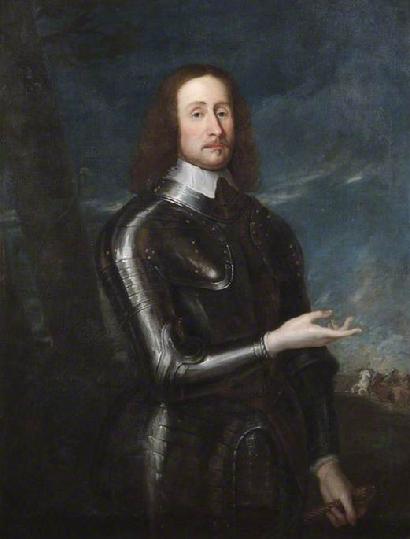
| John Hampden (1595-1643) |
|
| John Hampden,
Namesake of Our Town
Hamden became a town, separated from New Haven, when a petition from the Mount Carmel Ecclesiastical Society was accepted by the state General Assembly in 1786. Ordinarily, the town would take the same as the society. However, Amasa Bradley, who had been influential in the Mount Carmel Society, suggested it be named for the English statesman John Hampden, without the silent 'p'.
Born in 1595, Hampden protested the imposition of a ship money tax by King Charles I. While fighting for the Parliamentarians against the Royalists in the First English Civil War, he was shot, and died on June 24, 1643. Benjamin Franklin and John Adams cited Hampden's opposition to tyranny to justify the cause for American independence. Hamden was incorporated just three years after the conclusion of the Revolutionary War.
Amasa Bradley may also have suggested Hampden's name because his ancestor had fought in the army of Oliver Cromwell, who signed the death warrant of Charles I. His son Charles II regained the throne and persecuted those responsible for his father's execution, including the judges Edward Whalley, William Goffe, and John Dixwell, who fled to New Haven. Hampden himself wished to migrate to Connecticut in 1638, but his ship was prevented from sailing by royal order. So despite that John Hampden never visited the area that would become our town, and died 143 years before it was established, there is good cause for it to be named for him.
|
Several other places throughout the English-speaking world are named Hamden or Hampden. It is not always certain whether they are named for the statesman, others with the surname, or our town, which has a much greater population than all the others combined. The three closest places to Connecticut are also the only ones with populations over 1000: Hampden, Massachusetts; Hampden, Maine; and Hamden, New York (which, like our town, is on a State Route 10). Ohio has both a Hamden and a Hampden, the former also on a Route 40, the latter in the Western Reserve, an area that belonged to Connecticut prior to 1800. There is also a township of Hamden in Minnesota and places named Hampden in Wisconsin, the Canadian provinces of Québec and Newfoundland and Labrador, the Australian state of Queensland, and New Zealand. Baltimore, Maryland has a neighborhood of Hampden. Ironically, the Hampden with the smallest population, 29, in North Dakota, is also the only one that is an official city. One more place must be mentioned: John Hampden is buried in the English civil parish of Great and Little Hampden.
|
|